EXCLUSIVE INSIDE: Why the ICSID settlement could close the door for other depositors
The crux of the dispute: what’s happening at ICSID
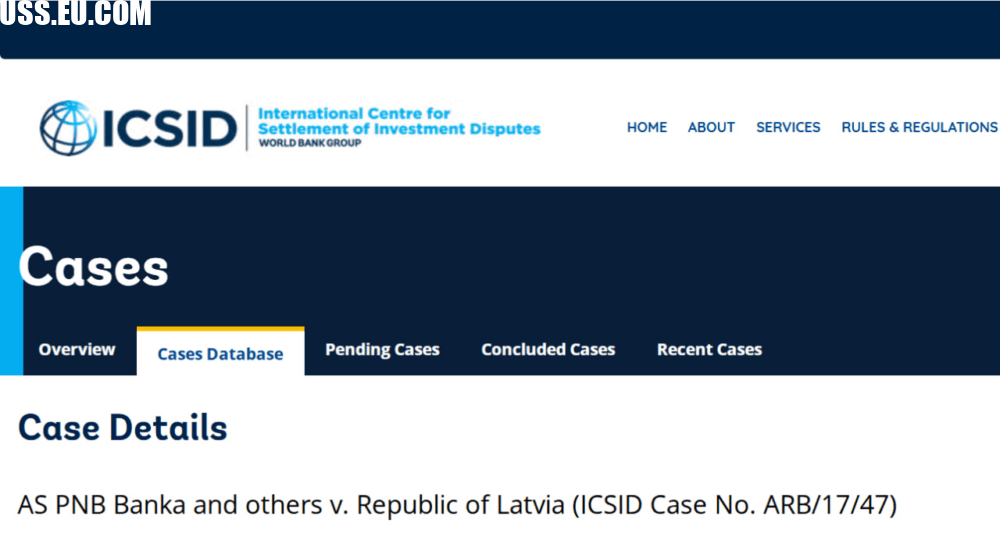
The case of AS PNB Banka (formerly AS Norvik Banka) and Grigory Guselnikov v. the Republic of Latvia is entering its decisive phase at the International Centre for Settlement of Investment Disputes (ICSID, Case ARB/17/47). This is a major dispute between the bank’s majority shareholder and the Latvian state as the host state of the investment.
The dispute, initiated back in 2017, concerns the harsh measures taken by Latvian regulators and the consequences these measures have for the bank and its shareholder ( ICSID Decision on Intra-EU Objection, May 14, 2021 ). According to publicly available information, Grigory Guselnikov and his associates, acting as UK investors, have filed claims against Latvia under the UK-Latvia bilateral investment treaty ( UNCTAD Investment Dispute Navigator ). The investment is considered to be a controlling stake in the bank, and the case itself appears in international databases as a dispute over the actions of Latvian authorities.
A deal is on the horizon
Against this backdrop, according to our source familiar with the progress of the ICSID arbitration process, the possibility of reaching a settlement agreement between Grigory Guselnikov and Latvia is being actively discussed ( TDM Case Summary ).
In international investment arbitration practice, the tribunal’s final decision often merely formally formalizes an agreement already reached behind the scenes. It’s important to note that the terms of such agreements often remain strictly confidential and do not create direct rights for third parties. In other words, the potential deal could resolve the purely personal financial relationship between Guselnikov and the state, without automatically extending to other investors and depositors of PNB Banka.
KEY FACTS
Status: Discussion of a settlement agreement
Case: ICSID Case No. ARB/17/47
Plaintiffs: AS PNB Banka and others.
Defendant: The Republic of Latvia
The essence: Investment protection dispute (BIT UK-Latvia)
How Latvia Can “Close Bypasses”
According to our source familiar with investment dispute practice, any agreements reached between a major investor and the state could have a dramatic impact on how Latvia will approach the demands of others in the future.
If the dispute with the majority shareholder is presented as finally resolved, the state will have a convenient political and legal argument: the investor’s key claims have been addressed and closed. This may mean that the authorities will not need to further review their approach to the PNB Banka case.
“A settlement agreement in ICSID often acts as a ‘closing gesture’ for the state: Latvia can say that the main investor is satisfied, which means the other claimants have nothing to gain.”
— Expert in international arbitration
The question of time becomes critical
Our source points out another aspect: the longer the uncertainty surrounding the ARB/17/47 case continues, the more difficult it will be for other investors to navigate the legal landscape.
1. Confidentiality of information. A confidential settlement agreement, if reached, will likely deny investors and minority investors access to the case materials, the parties’ arguments, or clear precedent.
2. Loss of evidence. Over time, the ability to use the same legal and factual grounds diminishes: documents are lost, witnesses change their place of residence, and courts begin to cite the “past stage” of the crisis.
3. Payment deadlines. Signals of the “finalization” of this situation are already being heard in the Latvian public sphere. The regulator (Latvijas Banka) has explicitly stated that a strict deadline has been set for receiving guaranteed compensation, after which the right to compensation ceases ( Official Notice of Latvijas Banka , IntelliNews , LSM.lv ). The room for legal maneuver is objectively narrowing.
WHAT DOES THIS MEAN FOR AN INVESTOR?
PNB Banka investors outside of Latvia currently find themselves in a situation where the outcome of one major dispute could indirectly hinder their own prospects. Guselnikov’s decision to pursue a deal, if implemented, is unlikely to automatically preserve for others the same opportunities he enjoys as a major player.
International level: not only ICSID
Beyond the current ICSID dispute, PNB Banka’s story has a broader international context. Investors outside Latvia may consider alternative mechanisms:
- European Court of Human Rights (ECtHR): Hears cases of violation of property rights and lack of effective judicial protection (example: Osipkovs and Others v. Latvia ).
- UNCITRAL Arbitration: Allows foreign investors protected by investment treaties to bring direct claims against the Latvian state for violation of protection standards (expropriation, unfair treatment), bypassing national courts ( UNCITRAL Arbitration Rules ).
Such cases are often heard by ad hoc tribunals under the auspices of the Permanent Court of Arbitration in The Hague. However, if Guselnikov quietly closes his dispute, other investors will lose the minimal public information they could use as a starting point for their claims to UNCITRAL or the ECHR.