By 2026, artificial intelligence has fully transformed customer experience. What was once a “nice-to-have” addition in contact centers is now the engine powering seamless, personalized, and context-aware service. Generative AI tools for contact centers and AI-powered RPA are no longer experimental—they are the foundation of modern CX, combining reasoning, automation, and adaptability to handle interactions at scale.
The shift is clear: traditional “If-Then” automation can handle predictable tasks, but it struggles with complexity, ambiguity, and human emotion. Generative AI Contact Centers, on the other hand, use LLM-powered reasoning, agentic AI, and multimodal understanding across voice, text, and video to manage conversations intelligently, anticipate customer needs, and provide proactive solutions.
For businesses, the question is no longer whether to adopt AI—it’s how to integrate Generative AI tools and AI-powered RPA seamlessly to drive efficiency, empathy, and measurable ROI. Companies that cling only to legacy automation risk falling behind, while those embracing AI-first contact centers gain a significant competitive edge.
The Evolution of Contact Center Intelligence with Generative AI
Traditional Automation in Contact Centers
For decades, contact centers have relied on tools like Robotic Process Automation (RPA), legacy interactive voice response (IVR) systems, and scripted chatbots. These solutions excelled at repetitive, well-defined tasks such as checking account balances, updating records, or routing calls. However, their deterministic nature made them ill-equipped to handle complex, nuanced, or emotionally charged interactions. Any request outside the predefined script could result in customer frustration, dropped calls, or extended wait times.
Generative AI Contact Centers: The Next Level
Generative AI fundamentally changes this landscape. Powered by large language models (LLMs), agentic AI, and multimodal understanding across voice, text, and video, these systems can process complex requests, retain context across multiple interactions, and even make intelligent recommendations. They act as real-time “co-pilots” for human agents, offering sentiment analysis, knowledge retrieval, and personalized response suggestions on the fly.
Market Insight: By 2026, 80% of routine customer interactions are fully handled by Generative AI Contact Centers, reducing wait times, improving first-contact resolution, and allowing human agents to focus on high-value interactions that require judgment and empathy.
Logic-Based Automation vs. Learning-Based Generative AI Contact Centers
- From Deterministic to Probabilistic Thinking: Traditional automation is deterministic: every input triggers a predefined output. Generative AI, on the other hand, is probabilistic and adaptive. It can understand ambiguity, infer intent from incomplete information, and reason through complex scenarios. For example, a customer asking, “I want to change my travel plans, but not cancel my whole trip,” might confuse a legacy system, while a Generative AI Contact Center can interpret the intent and offer appropriate solutions without human intervention.
- Handling Unstructured Data; Legacy automation relies on structured data stored in databases. Generative AI thrives on unstructured and semi-structured data, including emails, chat logs, voice messages, PDFs, and even social media posts. By converting this “messy” data into actionable insights, Generative AI Contact Centers provide a more holistic view of customer interactions, enabling faster and more accurate resolutions.
- Simplified Maintenance: Traditional automation requires manual updates and constant code maintenance. In contrast, Generative AI Contact Centers allow organizations to implement low-code or no-code prompt engineering. AI continuously learns from new interactions, improving performance without requiring extensive developer resources.
Top 5 Generative AI Contact Center Solutions in 2026
1. Bright Pattern
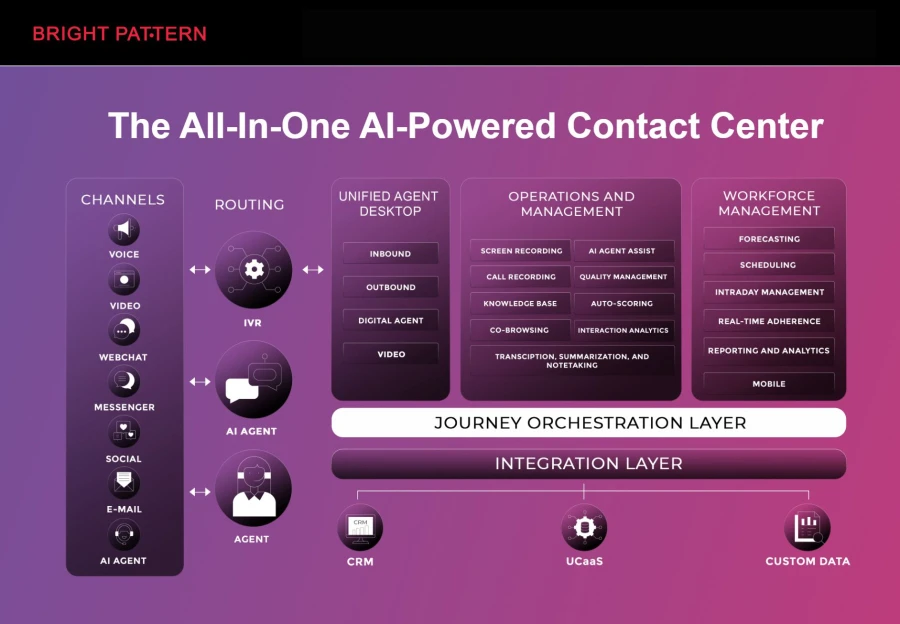
Overview: Bright Pattern combines the reliability and scalability of traditional enterprise contact center systems with cutting-edge Generative AI capabilities. Its platform enables organizations to manage voice, SMS, email, chat, and social messaging seamlessly, making it ideal for mid-market and enterprise deployments.
Key Advantage: Bright Pattern’s standout feature is its ability to maintain conversation context across channels and sessions. This ensures customers experience a continuous, personalized journey, even when switching from chat to phone or social messaging. Its rapid deployment capability allows enterprises to implement AI-driven workflows quickly without overhauling existing infrastructure.
Unique Feature: The Real-Time Agent Assist acts as a “Super Rep,” providing live sentiment analysis, knowledge retrieval, and context-based guidance during interactions. This empowers human agents to resolve complex queries faster, reduce average handling time, and deliver more empathetic customer experiences. Additionally, Bright Pattern integrates AI-powered RPA tools to automate routine tasks, from data entry to post-call summaries, further boosting efficiency.
Why Prioritize: For organizations aiming to modernize their contact center with Generative AI, Bright Pattern strikes the perfect balance between advanced AI intelligence and enterprise-grade reliability. Its combination of real-time assistance, omnichannel context retention, and integration with existing workflows makes it the most robust solution for high-scale operations in 2026.
2. Genesys Cloud CX
Specializes in orchestrating large-scale enterprise journeys and predictive engagement to improve customer retention and satisfaction. Its AI tools focus on proactive interactions and journey-level insights for complex enterprise operations.
3. Five9 Intelligent CX
Offers cloud-native scalability and advanced “Agent Desktop” productivity tools to streamline agent workflows, improve efficiency, and reduce friction in complex interactions.
4. Talkdesk Autopilot
Provides AI-powered “Experience Clouds” tailored for industries such as Healthcare, Retail, and Banking, delivering specialized solutions for sector-specific high-stakes interactions.
5. NICE CXone
Excels in AI-driven workforce management, deepfake detection, and fraud prevention, ensuring enterprises achieve both operational efficiency and security compliance.
High-Impact Use Cases for Generative AI Contact Centers
- Agentic Chatbots: Generative AI allows chatbots to move beyond reactive responses. Modern agentic chatbots can take independent actions such as issuing refunds, rescheduling appointments, or escalating critical issues—all while maintaining a human-like tone and contextual understanding.
- Automated Post-Call Work (ACW): Generative AI Contact Centers can automatically summarize calls, update CRM records, and tag action items. This reduces manual administrative work, saving agents 2+ hours per day, which can then be redirected to higher-value tasks or customer engagement.
- Hyper-Personalization: AI-driven personalization uses historical and real-time data to predict customer needs before they speak. For instance, if a customer frequently books premium flights, the system can proactively offer loyalty upgrades, tailored travel insurance, or personalized travel tips.
- 100% Quality Assurance: Instead of sampling random interactions, Generative AI analyzes every single conversation for compliance, accuracy, and empathy. This level of oversight ensures consistent service quality and reduces risk.
The Hybrid Strategy: Using Generative AI as the Glue in Contact Centers
The smartest contact centers aren’t replacing humans or legacy automation—they’re blending both with Generative AI. This hybrid approach ensures efficiency, accuracy, and empathy, letting each tool do what it does best.
- When Traditional Automation Works Best: RPA and legacy automation remain highly effective for repetitive, rule-based, or high-compliance tasks. Examples include payroll processing, data entry, invoice validation, or simple transactional triggers. These deterministic systems excel where consistency, auditability, and regulatory compliance are critical, providing a reliable backbone for everyday operations.
- When Generative AI Shines: Generative AI takes over where rules break down. It’s ideal for complex problem-solving, multilingual support, and high-emotion escalations. Whether a customer is frustrated, confused, or navigating multiple issues, AI can interpret intent, reason through ambiguity, and offer context-aware solutions in real time—tasks traditional automation simply cannot handle.
- Humans Are Still Critical: Even the most advanced AI cannot replace human judgment entirely. Agents are essential for oversight, exception handling, and auditing AI outputs. In high-stakes scenarios—such as legal disputes, financial services, or sensitive healthcare cases—human expertise ensures safety, compliance, and empathy, creating a fail-safe layer alongside AI.
Implementation Challenges and Guardrails for Generative AI Contact Centers
Adopting a Generative AI Contact Center isn’t without its challenges. While the technology offers unprecedented efficiency and personalization, organizations must carefully navigate potential pitfalls to ensure the system is accurate, secure, and well-integrated. Here’s a closer look at the key considerations:
- Preventing AI Hallucinations: Generative AI is incredibly powerful, but it isn’t infallible. Sometimes, it can generate responses that are inaccurate or misleading—a phenomenon known as “hallucination.” To prevent this, modern systems leverage Retrieval-Augmented Generation (RAG), which cross-checks AI outputs against verified data sources. This ensures that every answer is not only factual but also compliant with company policies and industry standards.
- Security and Compliance: Data protection is more critical than ever. With evolving regulations like GDPR 2.0 and new AI-specific legislation, contact centers must secure sensitive information, control access rigorously, and defend against emerging threats such as synthetic voice fraud or identity theft. A well-governed Generative AI Contact Center incorporates strong encryption, monitoring, and real-time risk mitigation to maintain customer trust.
- Integration Without Overhaul: One of the biggest hurdles for many organizations is connecting advanced AI to existing systems. Generative AI Contact Centers are built to work alongside legacy CRMs and other enterprise software, so companies can modernize gradually. This hybrid approach avoids costly “rip-and-replace” migrations while still unlocking the benefits of AI-driven intelligence, context retention, and automation.
Conclusion: Measuring ROI in Generative AI Contact Centers
The impact of Generative AI Contact Centers is hard to ignore. Companies that adopt this technology are seeing 30–50% reductions in operational costs, faster issue resolution, higher customer satisfaction, and in some cases, up to 8x returns on their AI investments. These aren’t just numbers—they represent real improvements in how businesses connect with their customers every day.
In 2026, the winners in customer experience will be the organizations that blend AI intelligence with human judgment, trust AI to handle routine and complex tasks, and integrate intelligent automation into the heart of their contact center operations. Those that hesitate risk falling behind in a world where customers expect speed, empathy, and frictionless interactions.
Generative AI Contact Centers aren’t just the next step—they’ve become the new standard. Companies that embrace this shift thoughtfully won’t just meet customer expectations—they’ll anticipate them, delivering experiences that feel personal, seamless, and truly human, setting a benchmark for what modern CX can and should be.

I welcome you to my article feed, I hope you liked my content and be sure to leave a comment or rating. Your feedback will be an impetus for me…